
The Rwanda Riparian Restoration Project.
Riparian buffer zones nationwide, Rwanda. A living barrier of clumping bamboo for the country’s rivers, protecting water, soils and slopes.
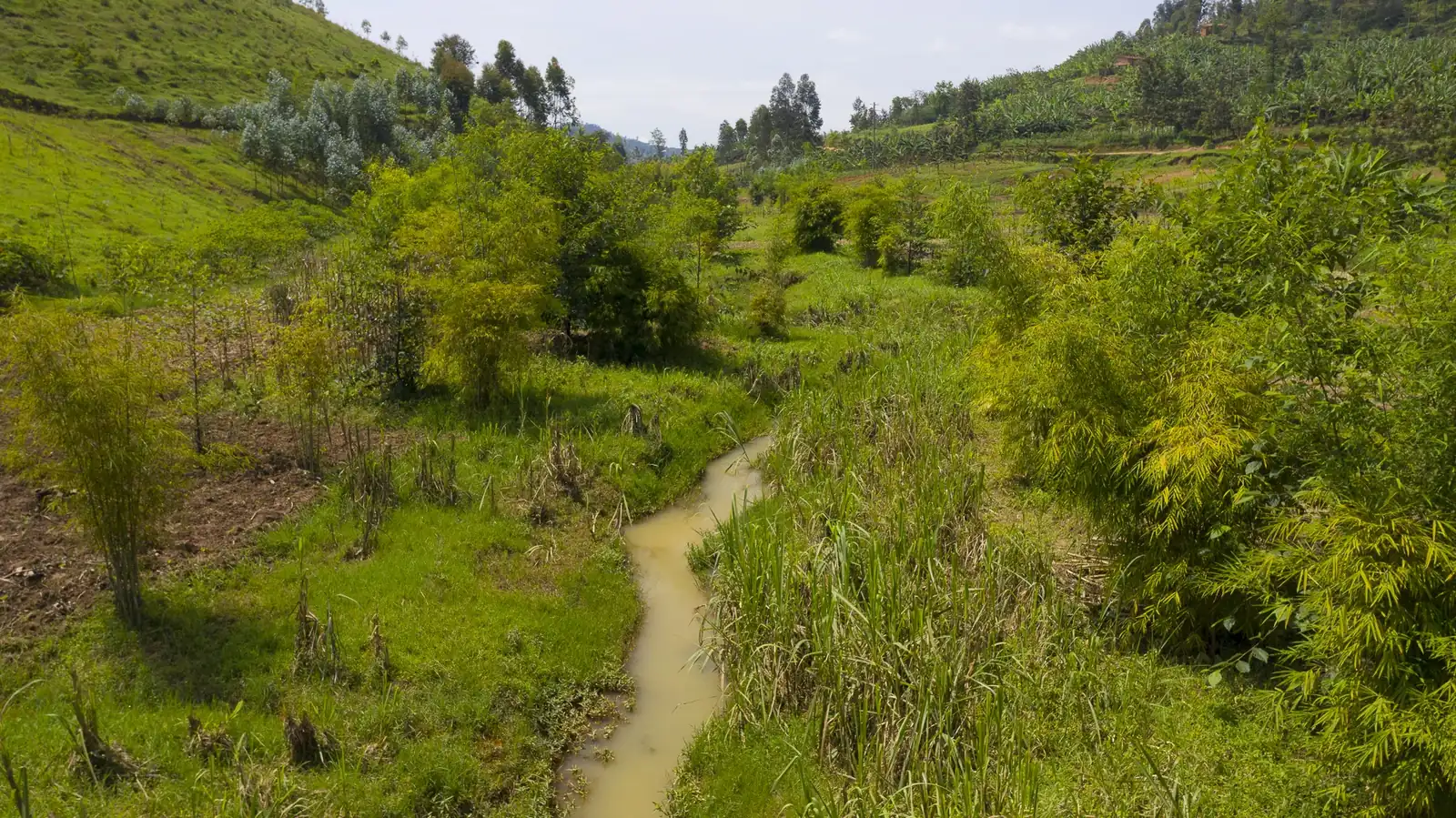
Rwanda’s riparian buffers, the strips of land lying directly against its rivers, are government-tenured and protected, yet fragile and exposed to the country’s heavy rains. Launched in 2022 after a three-year pilot grant-financed by the Government of the Netherlands, and delivered under a memorandum of understanding with the Rwanda Water Resources Board, the project plants non-invasive clumping bamboo along these banks: a living barrier that binds soils, softens heavy rainfall, and cuts flooding and siltation downstream. Registered by Verra in December 2023, with 2,170 hectares planted to date.
Registered by Verra in December 2023. The first 1,000 hectares, planted in 2022 and 2023, are under contract, and the total planted to date is 2,170 hectares. The project is also approved and registered under Rwanda’s National Carbon Registry and holds an approved Letter of Authorization. It is registered under methodology AR-ACM0003 and is expected to transition to VM0047 in 2027.
Across the full 4,500 hectares, the project is expected to remove approximately 2.4 million tons of CO₂e over its 20-year crediting period. Co-benefits are quantified under the SD VISta program.
3,500 ha available · 1,170 ha already planted · 2,330 ha scheduled for planting
Projected removals across this offering. Delivery subject to monitoring, verification and issuance. Full technical materials, delivery schedules and commercial terms are shared under NDA. All projected volumes are net VCUs, after the 12% VCS non-permanence buffer has been deducted.
Rwanda’s topsoil moves downhill. The riverbanks are where it stops.
Rwanda’s steep terrain, intensive agriculture and heavy rainfall create significant erosion pressure. Restoring protective vegetation along rivers helps stabilize vulnerable banks, intercept sediment and reduce the movement of soil into waterways. These narrow riparian areas can provide an important protective function.
Protected by law
Once planted, the restored buffers are protected under Rwandan law, with activity limited to health thinning, and the local districts share in the delivery fee that funds that protection for the long term.
Registration
Registered by Verra in December 2023 under VCS 3072, with SD VISta.
Planting window
The balance is planted over three seasons, 2026 to 2028.
Delivery profile
First issuance 2027, then biennial verification to 2037.
Tenure
The buffers are government-tenured, and protected under Rwandan law once restored.
Methodology
Registered under AR-ACM0003.
Diligence pack
Full technical materials are available under NDA: the validated project design document, carbon accumulation model and monitoring plan.
Strong government alignment
Rwanda protects its riparian buffers by law, and EcoPlanet implements the project under an MoU with the Rwanda Water Resources Board. Approval under Rwanda’s National Carbon Registry, including a Letter of Authorization and the availability of a corresponding adjustment for future VCUs, aligns the project with the country’s carbon framework.
Proven delivery
The project is well established, having planted 2,170 hectares in Rwanda since 2022. Partners can acquire hectares they can already see growing, with faster timeframes to issuance.
Impact on the ground
Our impact extends beyond the restored landscape. We engage openly with local stakeholders to understand community priorities and identify those most vulnerable, at risk of being left behind. These insights guide the design of initiatives that improve food security, access to water and practical skills development. By responding to locally identified needs and supporting greater self-reliance, we help build stronger, more resilient communities.
2,170 hectares are already in the ground, planted over four seasons.
2026 to 2028 plantings are the currently projected schedule.