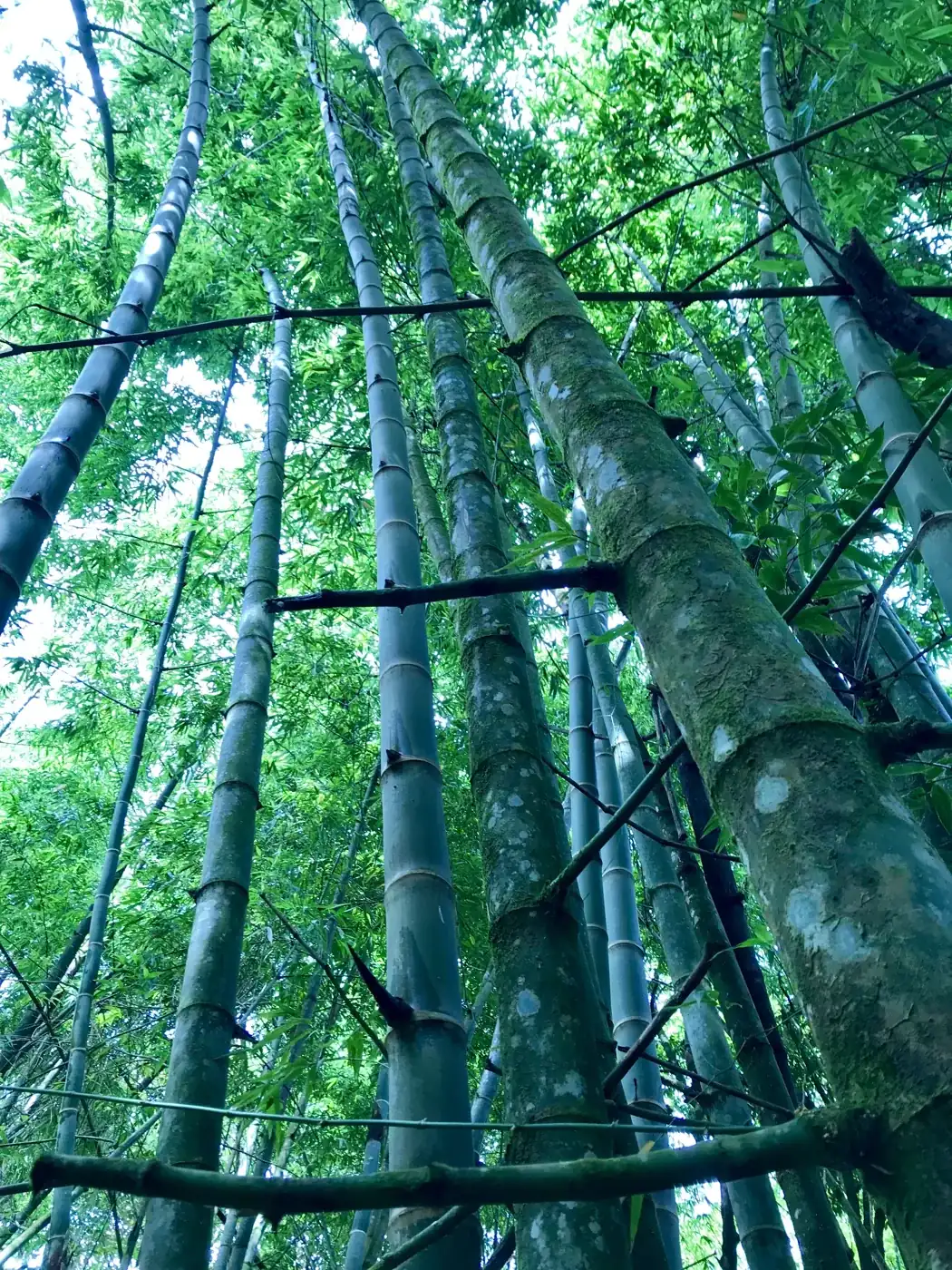
A grass that behaves like a forest.
Tropical clumping bamboo pulls carbon from the air as it grows, restores the ground it grows on, and yields a crop every year once it is mature.
The carbon math has changed. Cutting emissions is no longer enough. The world also has to pull billions of tons of CO₂ back out of the atmosphere, starting this decade. New removal technologies are racing to scale, and we need every one of them. The one that has always worked at scale is photosynthesis, plants pulling carbon from the air, the way they have for millions of years. The question is which plant to grow, how well it can be measured, and what it leaves behind for the people who tend the land.
Carbon drawdown, front-loaded. Then held for decades.
Bamboo is a grass, not a tree. That changes both the economics and the climate math: it reaches commercial maturity in six to eight years, draws down carbon quickly, and goes decades without needing replanting, because harvesting a pole stimulates new growth. The forest stays standing as a living carbon sink.
Mitigation
- Prevents deforestation and desertification
- Long-term CO₂ capture and storage
- Helps maintain rainfall patterns
Adaptation
- Reduces temperatures and creates microclimates
- Secures fuel source and food for livestock
- Generates livelihoods for vulnerable communities
The misunderstood part: of roughly 1,700 bamboo species, EcoPlanet grows only tropical clumping bamboo, tight, non-invasive clumps, a different organism entirely from the running bamboo that spreads through a garden. Common questions, answered below ↓
Why bamboo? We chose it.
Bamboo was a deliberate choice. Before planting a single culm, EcoPlanet went looking for a plant that could do three demanding things at once, and bamboo answered all three.
Restore degraded land
A fast-growing grass with a dense, binding root system, bamboo rebuilds soil, holds water and stabilizes ground too far gone for conventional forestry, restoring the land while it grows.
Earn its keep
Bamboo is a genuine alternative fiber and fuel: a renewable feedstock with real commercial value, so restoration can pay its own way rather than depend on subsidy.
Keep people working
Bamboo needs intensive care through its first four to six years, then selective harvesting every year after that, for good. It creates sustained, recurring local employment for the life of the forest.
The things people ask about bamboo.
Isn’t bamboo invasive? Won’t it spread?
Not the bamboo EcoPlanet grows. Of roughly 1,700 bamboo species, the invasive ones are temperate running bamboos, the kind that takes over a garden. EcoPlanet works exclusively with tropical clumping bamboo, which forms tight, compact clumps with no capacity to spread. It’s a fundamentally different organism from the plant most people picture, and it’s planted only on degraded land, never by clearing existing vegetation.
How does bamboo compare to planting trees?
They do different jobs, and EcoPlanet plants both. Bamboo reaches commercial maturity in six to eight years, against fifteen to twenty for tropical hardwood, so the carbon arrives sooner, with the majority of removals realized within roughly a decade of planting. Harvesting takes only select poles and stimulates new growth rather than killing the plant, so the forest is never clear-felled. Where a landscape needs native species, we plant native species: spekboom thicket in the Eastern Cape, and native trees alongside bamboo in the Philippines and Ghana.
If you harvest it, doesn’t the carbon get released?
No. Bamboo is harvested pole by pole without killing the plant; the root system regenerates continuously and the poles are replaced within a single growing season. The living carbon sink is maintained rather than reset, even under sustainable annual harvesting.
Does growing bamboo compete with food or farmland?
No. EcoPlanet plants only on land that has already lost its productive value: degraded, marginal ground that no longer supports agriculture. The model restores that land rather than converting active farmland or clearing natural forest, and 30 to 50% of every farm is permanently set aside for native species and conservation.
What does bamboo do beyond carbon?
A great deal. As a restoration species it rebuilds degraded soils, stabilizes water tables, reduces erosion, and reconnects fragmented habitat. It delivers both climate mitigation (carbon capture, reduced deforestation) and adaptation (cooler microclimates, secure rural livelihoods, resilience for vulnerable communities). The harvested fiber will displace tree-based pulp and packaging, extending the benefit down the supply chain.
Beyond bamboo.
Over the last fifteen years EcoPlanet has built deep expertise in large-scale land restoration: more than 2,000 team members, projects across five countries and three continents, and long-running partnerships with governments, corporations and conservation organizations.
We started with bamboo. Over time the platform has grown to include spekboom and other native species, chosen for what a particular landscape actually needs rather than for what we happen to grow.
If there is a project you think we could work on together, we would like to hear about it.
Start a conversation →