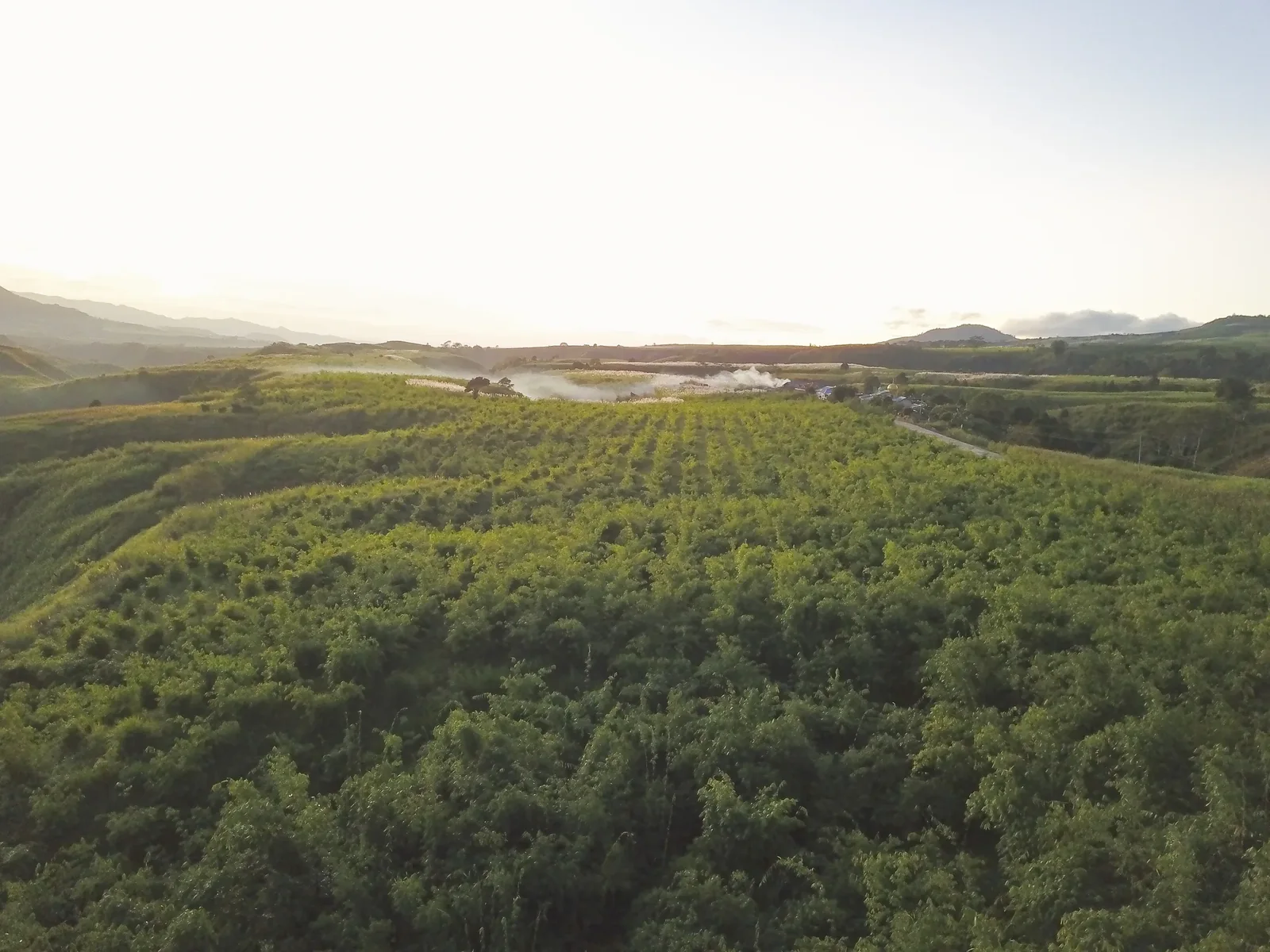
The Lanao del Sur Bamboo Reforestation Project.
Lanao del Sur, Mindanao, Philippines. Native bamboo restoring a degraded upland watershed that supports water supplies and food production in neighboring regions.
The Lanao del Sur Bamboo Reforestation Project restores a degraded upland watershed on the island of Mindanao, Philippines, that supports water supplies and food production in neighboring regions. Once covered by primary montane forest, much of the landscape was cleared more than a decade before the project began, leaving invasive grasses and scrub, with remnant trees and forest patches surviving in gullies and river valleys. Launched in 2022, the project uses carbon finance to restore the landscape through bamboo planting, native-tree restoration and conservation of the remaining forest.
Working under a 50-year lease on government timberland, EcoPlanet plants native Dendrocalamus asper, a clumping bamboo, among surviving trees and patches of native vegetation. The bamboo’s root systems help stabilize eroding slopes, while its canopy restores vegetation cover across the watershed. Older stems are selectively thinned as the clumps continue to grow. Native-tree planting outside the carbon accounting complements the bamboo program, and the remaining forest patches are conserved.
The project encompasses 8,360 hectares, including 5,000 hectares of bamboo and 400 hectares being formalized as farmland for resident families. The bamboo program is projected to generate approximately 3.19 million net verified carbon units over its 20-year crediting period. EcoPlanet planted 1,600 hectares between 2022 and 2025, with 3,400 hectares scheduled for planting in 2026 to 2029. The full bamboo program is available, spanning established plantings and the next phase of restoration. Registered under the VCS in November 2023 as project 2958, it advances ten UN Sustainable Development Goals, with first issuance expected in 2028.
5,000 ha available · 1,600 ha already planted · 3,400 ha scheduled for planting
Projected removals across this offering. Delivery subject to monitoring, verification and issuance. Full technical materials, delivery schedules and commercial terms are shared under NDA. All projected volumes are net VCUs, after the 12% VCS non-permanence buffer has been deducted.
A watershed restored, a province rebuilding.
Decades of conflict and instability left Lanao del Sur with degraded uplands and few formal jobs. Reforestation at this scale changes both. Women make up 47% of the team, and every planted hectare is paired with investment in the families who live in the watershed.
Bamboo within a wider landscape
The bamboo sits inside an 8,360-hectare mosaic of conservation, native tree restoration and planned regenerative farming, with the remaining forest patches set aside for conservation.
Technology-driven monitoring
AI-enabled drones, live dashboards and real-time monitoring measure planting and carbon across every hectare, supporting the MRV an accredited body then verifies.
Registration
Registered with Verra under VCS 2958.
Planting window
The remaining 3,400 hectares are planted over four seasons, 2026 to 2029.
Delivery profile
First issuance 2028, then biennial verification to 2038.
Permanence
Removals complete within eight years of each planting. The forest is managed as a permanent carbon sink for more than sixty years, on a 50-year renewable land lease.
Methodology
Registered under AR-ACM0003, migrating to VM0047 at first verification.
Diligence pack
Full technical materials are available under NDA: the validated project design document, carbon accumulation model and monitoring plan.
Strong government alignment
EcoPlanet operates on government timberland under a 50-year lease that provides the basis for long-term restoration and management. The regional environment ministry has also approved 400 hectares within the project boundary as formal farmland for resident families, bringing local livelihoods into the landscape’s restoration.
Proven delivery
EcoPlanet planted 1,600 hectares in the 2022 to 2025 seasons, with a project nursery and local team in place, providing 14 full-time positions and up to 142 seasonal positions. Registered under the VCS in November 2023, it offers hectares already growing alongside the next phase of planting, with first issuance in 2028.
Impact on the ground
EcoPlanet is helping address the fundamental needs of communities within our project area by constructing sanitation facilities, installing solar lighting and establishing rainwater-harvesting systems that improve access to clean water across three communities. Working alongside our local partners and engaging directly with residents, we are developing solutions that respond to local priorities and improve everyday well-being.
1,600 hectares are already in the ground, planted over four seasons.
2026 to 2029 plantings are the currently projected schedule.
Restoring a watershed, rebuilding after conflict.
Remaining forest patches within the boundary are set aside for conservation.
Nursery jobs
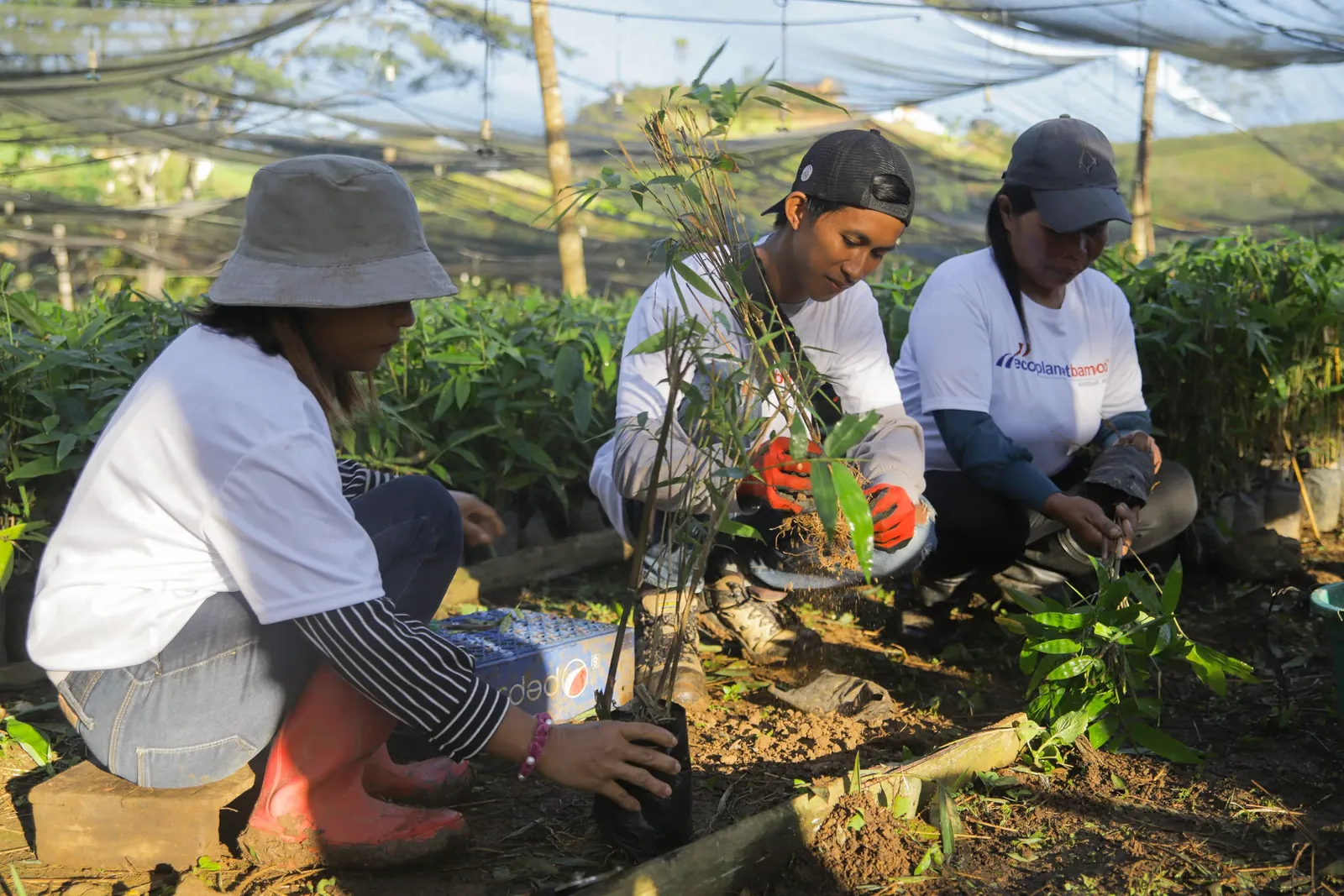
A full-scale nursery, staffed locally, produces every seedling the project plants. The work is steady and skilled.
Women in the workforce
Women make up 47% of the team, from nursery production to field monitoring and administration.
Community partnership
Ongoing consultation with the communities of the project area shapes where and how every block is planted.
The full Philippines impact story →
These are a few spotlights from this project. EcoPlanet delivers community, workforce and ecosystem projects across all of its operations, with more underway. Explore the full range on our Empowering Communities page, or contact us to discuss extending impact alongside this project.