
Eastern Cape Restoration Project, Somerset East.
Sand River Sanctuary, Somerset East, South Africa. Spekboom thicket restoration, and a future home for elephant and black rhino.
Registered with Verra as Eastern Cape Restoration Project, South Africa – Somerset East. Known within EcoPlanet as Sand River Sanctuary; the two names refer to the same project.
Decades of overgrazing and prolonged drought have severely degraded native Albany thicket in South Africa’s Eastern Cape, leaving former grazing lands with depleted soils and little remaining vegetation. The Eastern Cape Restoration Project uses carbon finance to restore these lands within a globally recognized biodiversity hotspot, rebuilding native habitat while creating rural employment. It is registered with Verra and listed on South Africa’s National Carbon Registry, enabling domestic compliance sales alongside the voluntary market.
Ex ante estimate, crediting period 2023–2063, delivery 2030–2055. Delivery subject to monitoring, verification and issuance; no VCUs issued to date.
EcoPlanet plants Portulacaria afra (spekboom), a native species adapted to the region’s semi-arid conditions. Planted at high density and protected from grazing during establishment, spekboom develops a dense canopy that helps restore the shaded, moisture-retaining conditions in which other native thicket species can regenerate. Remaining intact thicket is conserved. As the vegetation recovers, it captures and stores atmospheric carbon, linking carbon removal directly to the restoration of the native ecosystem.
The project encompasses 10,300 hectares, with 8,845 hectares designated for restoration and approximately 3.2 million net verified carbon units projected over its 40-year crediting period. EcoPlanet planted 3,470 hectares between 2023 and 2025, and anchor buyers have contracted allocations totaling 7,120 hectares. The remaining 1,725 hectares are available to new partners, with planting scheduled across the 2027 to 2029 seasons. Registered under Verra’s Verified Carbon Standard in February 2025 as grouped project 3628, the project can incorporate additional eligible farms over time. It advances twelve UN Sustainable Development Goals, with SD VISta validation under way, and the long-term vision is to establish Sand River Sanctuary, an elephant and rhino sanctuary.
1,725 ha available, all of it new planting for 2027 to 2029 · 3,470 ha planted and 7,120 ha under contract to anchor buyers
All projected volumes are net VCUs, after the 12% VCS non-permanence buffer has been deducted.
A century of overgrazing, and the thicket coming back.
Twenty-six kilometers from Pearston, in a semi-arid reach of the Eastern Cape, lies land a century of overgrazing left economically unviable: former grazing farms stripped of the native subtropical thicket that once covered them. The Eastern Cape Restoration Project is bringing that ecosystem back, replanting Portulacaria afra (spekboom). The project area runs to 10,300 hectares, of which 8,845 are being restored, and 3,470 hectares have been planted so far. With the adjoining expansion, the restoration spans more than 10,000 hectares.
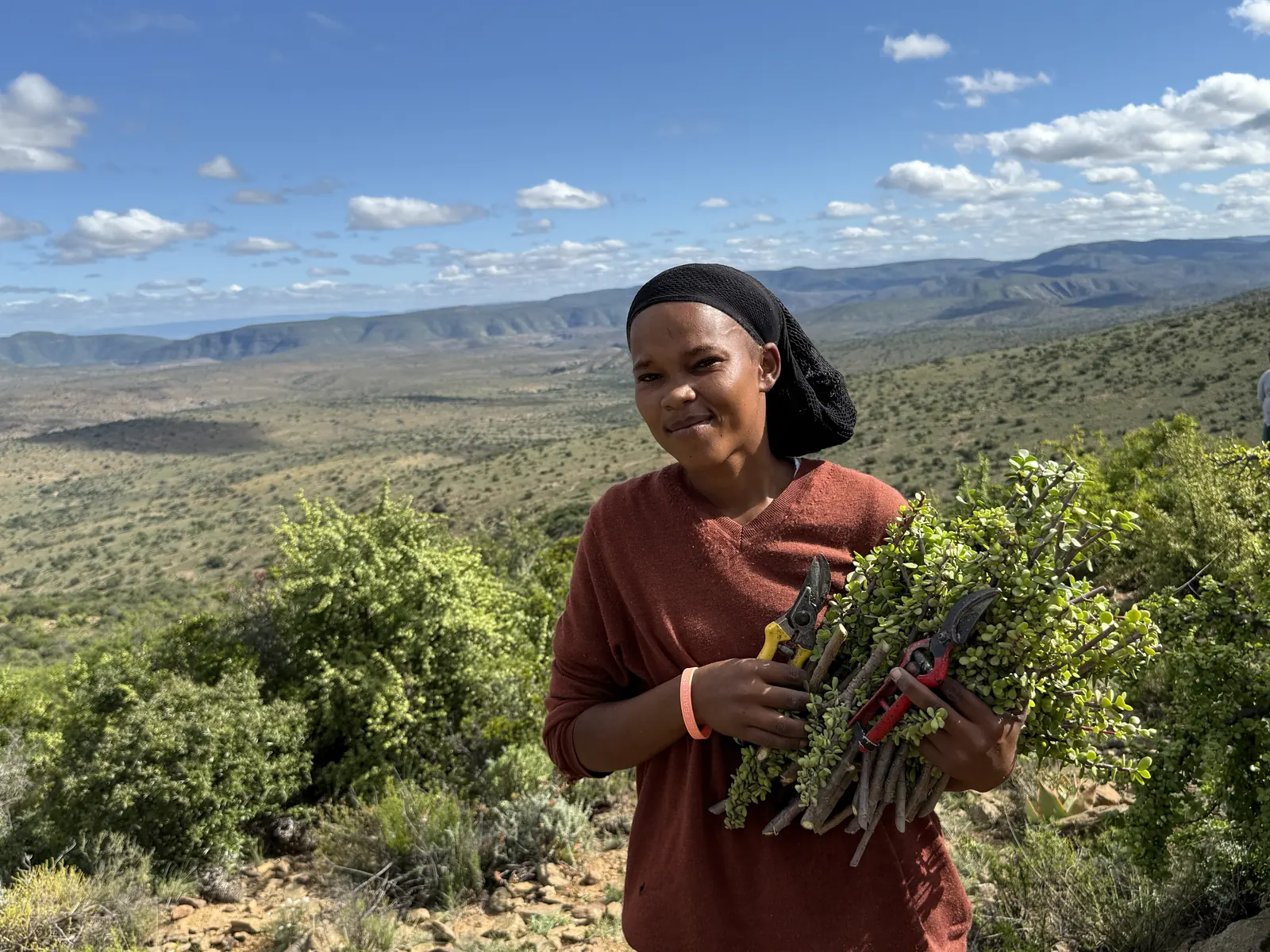
Why spekboom
Spekboom is one of the defining species of South Africa’s subtropical thicket, and uniquely suited to restoring it. It forms a dense evergreen canopy that holds soil moisture, halts erosion and shelters other native species as they return. Through a water-thrifty form of photosynthesis, it opens its pores at night to keep drawing down carbon while losing almost no water, making it extraordinarily drought-tolerant where little else survives. It grows from cuttings, so establishment needs no irrigation, and as the canopy closes the soil recovers and organic matter builds.
A measurable contribution to climate
Scientific studies estimate that intact spekboom thicket can store more than 200 tons of carbon per hectare, and that restored sites can approach those levels within 35 to 50 years, given favorable conditions and well-managed browsing. The risks the science flags, frost, poor soils and uncontrolled browsing, are actively managed here.
The returning thicket brings back the wildlife it shelters. Together with the neighboring project, this land is becoming a contiguous conservation sanctuary of more than 10,000 hectares, a future home for the African elephant and the critically endangered black rhino.
Registration
Dual registration: Verra VCS 3628 and the South Africa National Carbon Registry.
Planting window
1,725 hectares of spekboom planted across three seasons, 2027 to 2029.
Delivery profile
First issuance 2030, then triennial verification through to 2055.
Permanence
100-year permanence. Spekboom thicket is restored rather than harvested, so the carbon is committed to the land for a century.
Methodology
Registered under AR-ACM0003, migrating to VM0047.
Diligence pack
Full technical materials are available under NDA: the validated project design document, carbon accumulation model and monitoring plan.
Secure land and tenure
The project farms are freehold land owned by EcoPlanet and dedicated by board resolution to restoration and conservation. An application has been lodged to designate the farms as a Protected Environment under South Africa’s Protected Areas Act. EcoPlanet manages the land directly for long-term conservation, with no harvesting.
Proven delivery
EcoPlanet planted 3,470 hectares across the 2023 to 2025 seasons, with a trained local team in place to support further planting. Registered under Verra’s Verified Carbon Standard in February 2025, the project has allocations totaling 7,120 hectares under contract to anchor buyers. First project issuance is expected in 2030.
Impact on the ground
EcoPlanet is committed to supporting the long-term development of Pearston, the town where all our workers reside. We provide year-round employment for 150 local workers, 48% of whom are women, ensuring that the benefits of our restoration activities remain rooted within the community. Through a multi-year impact program, we have delivered initiatives that strengthen skills, education, healthcare, employment and local economic development, with further projects planned to create lasting opportunities for Pearston’s residents.
3,470 hectares are already in the ground, planted over three seasons.
2026 to 2029 plantings are the currently projected schedule; 575 hectares of each 2027 to 2029 season are available to new partners.
The community work it supports.
Volkswagen ClimatePartner at Sand River Sanctuary
We partnered with them on the Eastern Cape Restoration Project: spekboom thicket restoration across a conservation sanctuary of more than 10,000 hectares, being developed as a future home for elephant and black rhino. They sent a crew to film what their backing actually built.